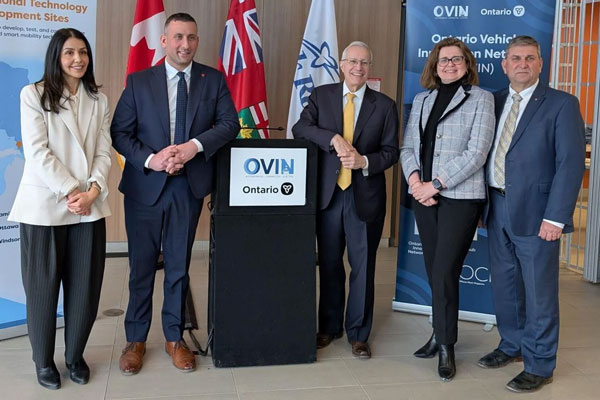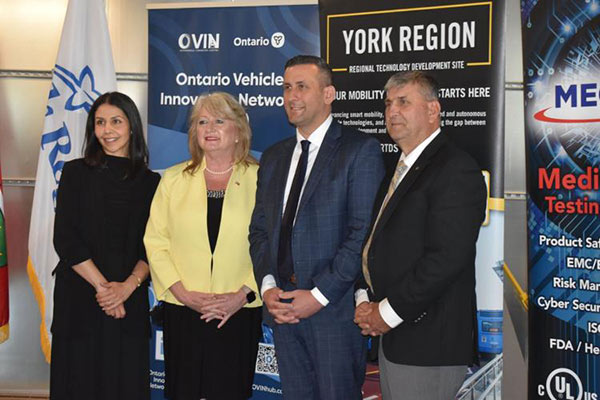
The York Region RTDS

The Ontario Vehicle Innovation Network (OVIN) Regional Technology Development Sites (RTDS) support Small and Medium-sized Enterprises (SMEs) to develop, test and prototype their advanced automotive technologies and smart mobility solutions, and tap into specific advice, expertise and knowledge around key focus areas for the sector.

The York Region RTDS is dedicated to advancing smart mobility, electrification, connected and autonomous vehicle technologies and automotive AI. This RTDS will help SMEs progress through Technology Readiness Levels (TRL) 1–7, bridging the gap between research, development, and commercialization.

Additional information about the application process is coming soon.

Applications for the RTDS are open!

How Can Your SME Benefit From The RTDS?

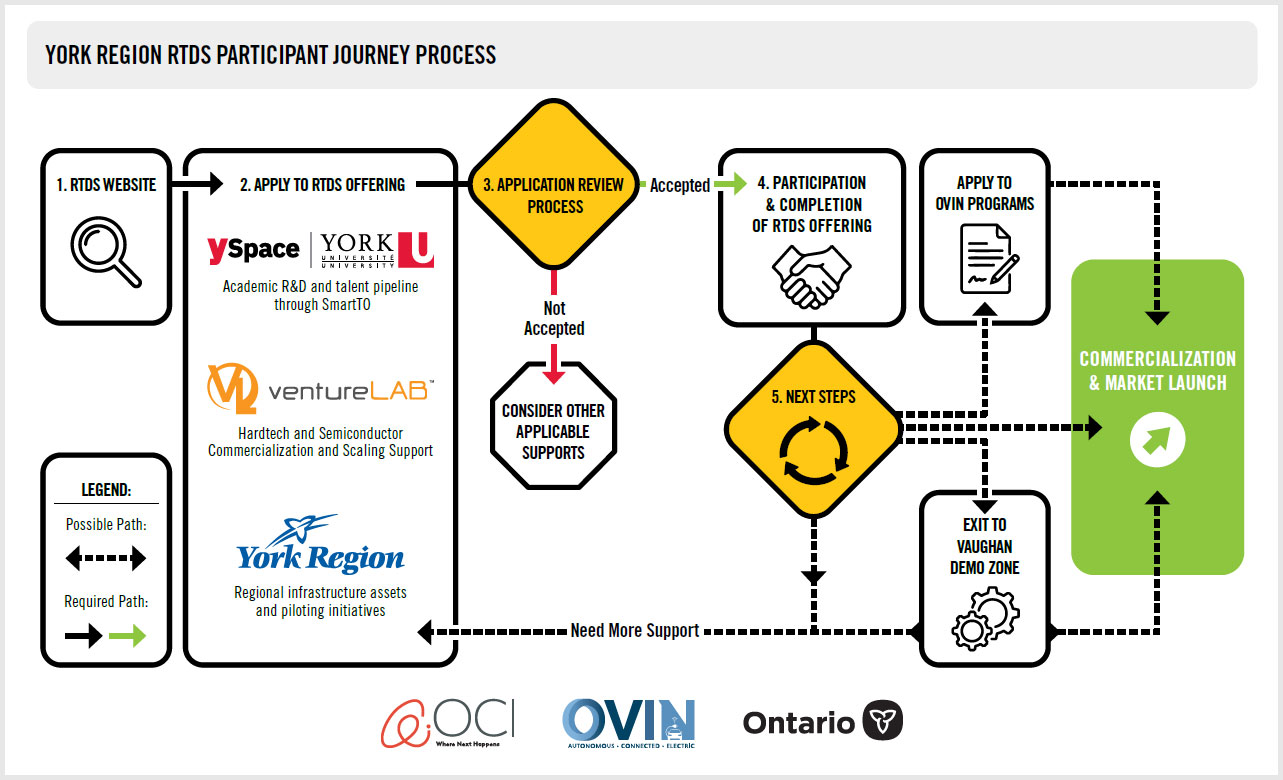
In partnership with OVIN, York University and ventureLAB, the York Region RTDS features 12 integrated offerings spanning the full innovation lifecycle from ideation to commercialization.

Through York University – YSpace, early-stage companies can gain access to cutting-edge labs, research, and talent in areas like smart materials, electrification, and system reliability.

With ventureLAB, later-stage firms can benefit through the Hardware Catalyst Initiative (HCI), Canada’s only hardware and semiconductor-focused incubator, offering prototyping labs, commercialization services, and global connections.

York Region provides critical infrastructure and real‑world testing environments, including YorkNet’s dark fibre network, municipal fleet vehicles, open data, and promotional support to help SMEs pilot, validate, and scale their technologies.

Explore additional details of the integrated offerings provided by each RTDS partner organization: 

  • Matching startups with expert York University faculty and graduate students to complete short-term technical projects (1–3 months), access specialized labs and prototyping facilities
  • Sector-specific accelerator for automotive, smart mobility, electrification, and transportation startups
  • Present priority challenges in mobility, sustainability, or smart-city operations in partnership with municipalities, public agencies and corporations
  • A pre-accelerator program supporting early-stage smart mobility entrepreneurs and academic researchers, offering workshops, mentorship, and venture-building tools
  • Fosters cross-sector collaboration, education, and community growth across Ontario’s automotive, mobility, and smart city ecosystems
  • Support mobility startups with technical resources, creativity, and direct exposure to emerging talent
  • Support companies developing chips, sensors, power electronics, and battery-management silicon for smart mobility.
  • Support Ontario-based startups advancing TRL 5–8 technologies in electrification, battery systems, lightweight materials, and AI-integrated components – accelerating commercialization and supply chain integration
  • Address rising productivity and innovation needs across Ontario’s auto supply chain, helping SMEs stay globally competitive while strengthening local capabilities and job creation
  • Provides a unique and powerful “living lab” environment for hosting pilot initiatives that enable testing and validation of smart mobility and advanced automotive technologies
  • Support projects requiring cybersecurity and sensitive data handling, offering high-bandwidth, low-latency connectivity essential for mobility pilots and simulations through its extensive dark fibre and conduit network
  • Offers access to infrastructure and assets that can serve as real-world test platforms for connected, automated, and sustainable mobility innovations

Frequently Asked Questions

Ontario-based SMEs with fewer than 500 employees.

Supports are offered at no cost to eligible SMEs through the combined investment from OVIN and York Region.

The site helps Small and Medium-sized Enterprises (SMEs) progress through Technology Readiness Levels (TRL) 1–7.

These are the 9 technology readiness levels (TRL), according to the Government of Canada, with 1 being the least ready and 9 being already used in real-life conditions.

Level 1: Basic principles of concept are observed and reported
Scientific research begins to be translated into applied research and development. Activities might include paper studies of a technology’s basic properties.

Level 2: Technology concept and/or application formulated
Invention begins. Once basic principles are observed, practical applications can be invented. Activities are limited to analytic studies.

Level 3: Analytical and experimental critical function and/or proof of concept
Active research and development is initiated. This includes analytical studies and/or laboratory studies. Activities might include components that are not yet integrated or representative.

Level 4: Component and/or validation in a laboratory environment
Basic technological components are integrated to establish that they will work together. Activities include integration of “ad hoc” hardware in the laboratory.

Level 5: Component and/or validation in a simulated environment
The basic technological components are integrated for testing in a simulated environment. Activities include laboratory integration of components.

Level 6: System/subsystem model or prototype demonstration in a simulated environment
A model or prototype that represents a near desired configuration. Activities include testing in a simulated operational environment or laboratory.

Level 7: Prototype ready for demonstration in an appropriate operational environment
Prototype at planned operational level and is ready for demonstration in an operational environment. Activities include prototype field testing.

Level 8: Actual technology completed and qualified through tests and demonstrations
Technology has been proven to work in its final form and under expected conditions. Activities include developmental testing and evaluation of whether it will meet operational requirements.

Level 9: Actual technology proven through successful deployment in an operational setting
Actual application of the technology in its final form and under real-life conditions, such as those encountered in operational tests and evaluations. Activities include using the innovation under operational conditions.

Still not sure what TRL your project is at? Check out the TRL assessment tool to help you narrow it down.

Together with our service delivery partners, York University and ventureLAB, the York Region RTDS provides SMEs with access to state-of-the-art equipment, labs and research centres located at various physical sites including:

  • York University (Keele Campus)
  • York University – YSpace Markham
  • ventureLAB Innovation Centre (Markham)

Support varies based on your project needs, but can include:

  • Access to specialized equipment, hardware and software
  • Access to infrastructure and assets for piloting new technologies and solutions
  • Access to business and technical advisory services
  • Access to a global network of partnership opportunities

While the RTDS is based in York Region, eligible Ontario‑based SMEs can apply. 

Support duration varies based on your project needs and the services you access. Some projects may be shorter or longer depending on scope, readiness level, and partner availability.

Send your questions to: rtds@york.ca

York Region RTDS News

York Region RTDS Partners

Do you have additional questions?

Subscribe to

Our Newsletter!

The York Region Business Update monthly newsletter recaps top business news stories, funding programs, local business events and other information related to the York Region Business community.

*All fields are required.

You can unsubscribe at any time. By clicking subscribe, you acknowledge that your information will be transferred to Mailchimp for processing.

Privacy information: York Link Privacy Policy | Mailchimp Privacy Practices